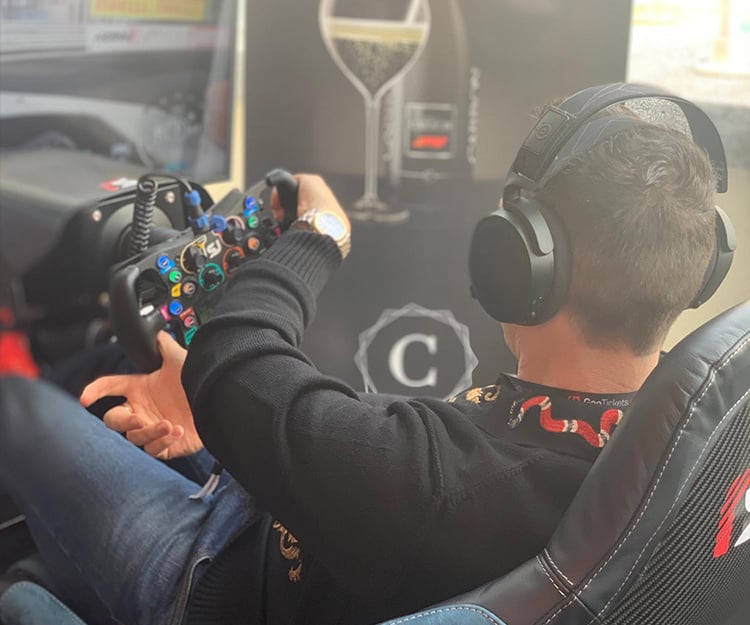
Why haptic feedback is essential in simulation
Haptic feedback plays a much more important role in simulation than we think. It is what connects the driver to the car and the track. Without this physical feedback, often all that remains is the steering wheel to convey sensations—this is useful but limited. You can feel the steering and the resistance, but not the life of the car.
The human body is designed to respond to physical signals such as vibrations, shocks and changes in pressure. Haptics recreates these cues that the simulator alone cannot reproduce. Result: we no longer drive solely with our eyes and hands, but also with our bodies.
In a conventional simulator, these cues disappear almost completely. With D-BOX actuators, they return in a clear and usable form. Haptic feedback recreates essential signals—loss of grip, weight transfer, track texture—helping the driver read the car, anticipate its reactions, and gain precision lap after lap.
The D-BOX effect, according to a haptic developer
For Félix Gervais-O’Neill, haptic developer at D-BOX, the relationship between haptics and performance is clear.
“My role as a haptic developer is to make sure a game outputs the right telemetry data that I can use to generate haptic feedback that simulates real-life sensations.” In short, haptics serves as a bridge between data and the body. It translates the physics of the game into sensory language.
Each haptic profile he designs has the same goal: to help the driver better understand what is happening under their wheels. “A haptic profile is a combination of haptic effects that will make you feel, through your body, that you are in the correct vehicle for the context.” These micro-signals make all the difference. They allow the driver to anticipate rather than simply react.
Félix also highlights the unique complexity of sim racing: “Unlike a movie, nothing is scripted. Every lap is different, with every driver driving in their own way.” This unpredictability forces developers to design consistent and accurate feedback, regardless of the conditions. The goal is to maintain a stable and natural feel so that the driver can keep up the pace, avoid mistakes, and improve consistency.
Over time, he says, drivers become more attentive to what they feel. “You become more sensitive to the effects, and you can feel how a car is supposed to behave on a specific track.” And that’s precisely where the secret of the best laps lies: this ability to stay just below the breaking point, without ever crossing it.
In short, haptics not only makes simulation more immersive, it makes it more accurate. It allows the driver to interpret the machine, understand its reactions, and push its limits, one tenth of a second at a time.
How haptics is tangibly improving lap times
Haptics is a bit like a translator between the car and the driver. It takes mechanical information (e.g., weight transfer, loss of traction, and excessive braking) and transforms it into physical sensations. These signals, which the body understands instinctively, allow the driver to react faster, more naturally, and above all, more precisely.
Better braking
Feeling the front end lighten, sensing the car vibrate just before a wheel locks up... These haptic clues provide a level of anticipation that is impossible to replicate with the steering wheel alone. The driver knows exactly when they are approaching the grip limit and can adjust the pressure on the pedal at the right time. The result is more gradual, shorter, and more consistent braking, lap after lap.
Managing traction with finesse
Thanks to micro-vibrations and chassis movements, the driver can feel when the car loses a little grip, well before it becomes apparent on the screen. Whether it’s a slight understeer, sliding, or wheelspin, these sensations become real cues.
“You can feel the exact moment when the car loses traction,” says Anthony Alfredo. This immediate feedback allows for earlier corrections, more precise adjustments, and prevents loss of control.
Reading the track with your body
Vibrations, bumps, changing surfaces... everything can be read. The body “sees” the track before the eyes. Using this haptic feedback, the driver can prepare their next move as soon as they feel a change. Each micro-shock becomes a message that the brain interprets instantly. In an environment as fast paced as a race track, this ability to anticipate makes all the difference—sometimes just a few hundredths of a second, but enough to beat the clock.
Keeping up the pace
Performance isn’t just about doing a good lap; it’s about repeatability. Haptics helps to create this regularity. By always reproducing the same type of feedback, it allows the driver to recognize the right sensations and reproduce them. Fewer errors mean more consistency.
The D-BOX effect, according to Anthony Alfredo, professional NASCAR driver
Haptics has completely changed the way Anthony Alfredo drives.
“Without haptics, you mainly react to what you see and what you feel in the steering wheel,” he explains. But with a haptic system, everything becomes clearer. “You feel the suspension, the bumps, ... even grip of the tire.” In short, you feel the car live.
These physical signals have become, in his view, an indispensable cue. “Haptics help you push the car a little further, because I can understand how the car is reacting and ultimately respond accordingly from behind the wheel.”
In simulation, where G-forces aren’t there to warn you, these sensations replace the natural cues a driver would have on a real track.
Anthony also underscores the impact of haptics on consistency: “When you can feel what works, you can repeat it.” And that’s what’s key. For him, consistency is what transforms a few isolated good laps into a real race pace. A fast driver is, above all, a driver who can be precise, time after time.
But he insists that this advantage doesn’t apply to just professionals. "Wether they are a real driver training or just an enthusiast, it gives you a more realistic experience and ultimately more feel to be able to push the car further and closer to its limit, which is ultimately necessary to improve lap time.” He sees this technology as both a learning tool and a means of advancing.
For Anthony, it’s simple: feeling the car is what makes all the difference between driving... and just playing at driving.
Science and feeling: why it really works
If haptics really helps you go faster, it’s not just a feeling: it’s proven. Science does a good job explaining why these physical sensations have a direct impact on performance.
The human body reacts much faster to a tactile signal than to visual information. When a driver feels a vibration or slight skid, their body reacts almost instinctively, without waiting for their brain to analyze everything. In other words, it anticipates rather than reacts—and that’s where precious fractions of a second are gained.
A study published in Electronics (Wang, 2022) shows that haptic systems improve vehicle control while reducing reaction time and mental load for the driver. To put it simply: the driver spends less energy interpreting what they see and can focus on what they feel.
Another more recent study, Force Feedback Drives Sim Racing Performance (Kim, 2025), goes even further. It shows that sim racers achieve significantly better lap times when their steering wheel incorporates medium-intensity haptic feedback, compared to driving without feedback. This feedback helps them to correct better, maintain a more consistent pace, and react more quickly to loss of grip.
These studies confirm what drivers and engineers in the field have been experiencing: haptics creates a sensory loop between humans and machines. Every vibration becomes information. Every micro-movement is a message that the body understands even before the brain formulates it.
As haptic developer Félix Gervais-O’Neill so aptly puts it: “Haptics doesn’t copy reality—it recreates the signals that the brain expects in order to understand it.”
And that’s where it all makes sense. Haptics translates physics into sensation, and this sensation is what transforms a realistic simulation into a real performance tool.
Sim racing without haptics isn’t true simulation
Haptics is not a gimmick. It is a bridge between the machine and the driver.
It gives the body back the signals that simulation takes away: the little vibrations, weight transfers, and tire vibrations that you can’t see on the screen, but you can feel.
Haptic developers know it, and drivers confirm that when you can feel the limit, you learn to control it. And once you control it, you can push it back.
That’s where the difference between a good lap and a great one lies—in that split second when the body acts before the brain has even made the decision.
Haptics does more than just add realism. It transforms simulation into a real learning and performance tool.
Because, ultimately, driving fast isn’t just a question of technique.
It’s all about how it feels. And thanks to haptics, these sensations can finally be measured.

Sources:
- Wang, H., et al. Review on Haptic Assistive Driving Systems Based on Drivers’ Steering-Wheel Operating Behavior. Electronics (MDPI), 2022.
- Kim, J., et al. Force Feedback Drives Sim Racing Performance: The Influence of Force and Vibrotactile Haptic Feedback in Simulator Steering Wheels. SSRN preprint, 2025.
- Jiao, Y., et al. Haptic Feedback of Front Car Motion Can Improve Driving Control. arXiv preprint, 2024.
- Driessen, L., et al. Investigating the Vibration Used in Sim Racing Steering Wheel Haptic Feedback. ResearchGate, 2023.